Utrecht Tells You to Come, Then Tells You to Leave: A King's Night Masterclass in Bureaucratic Whiplash
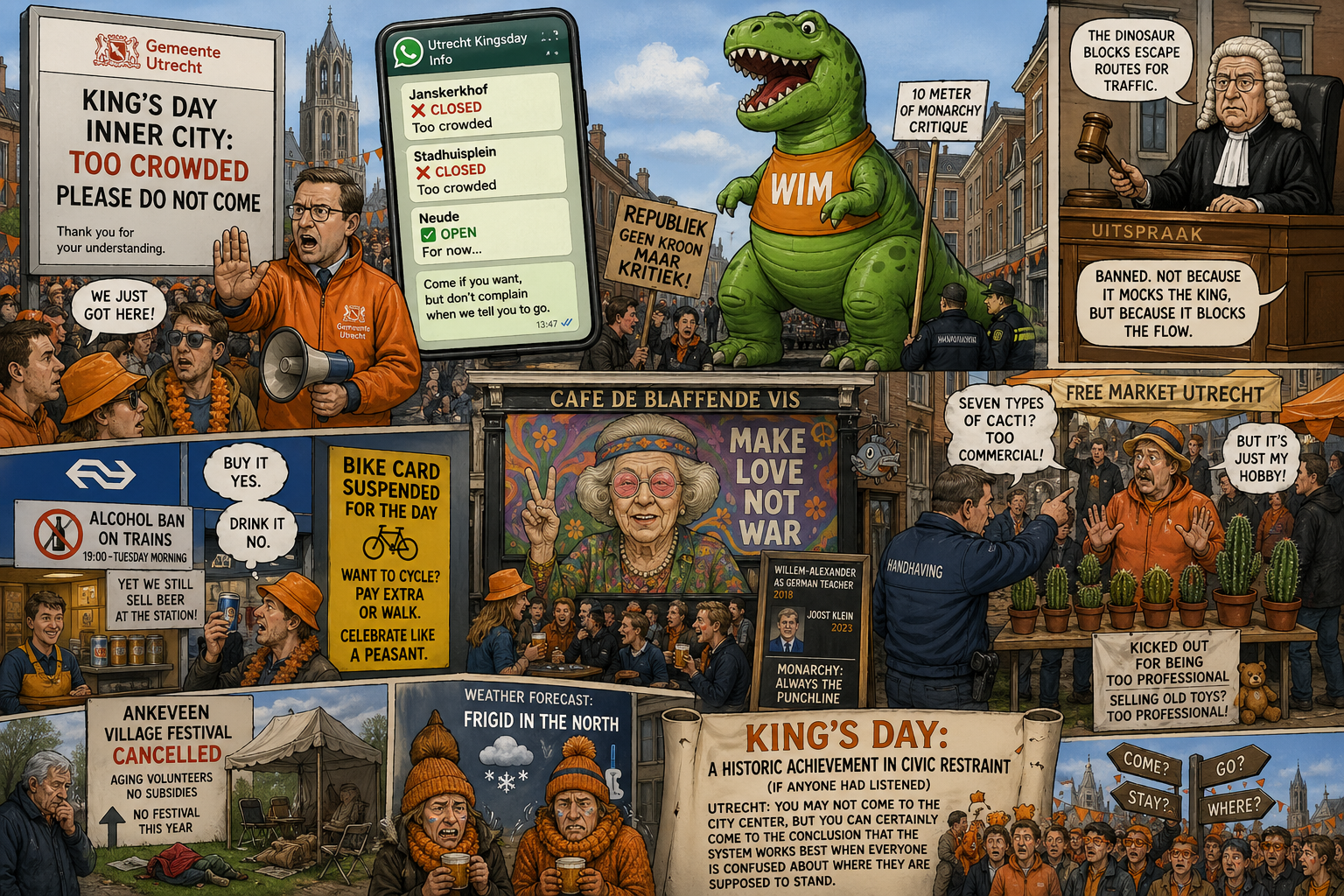
In a stunning display of logistical whiplash, the municipality of Utrecht has decided that King’s Night is best enjoyed by arriving at the city center and then immediately being told to leave. The local government issued a press release urging citizens not to come to the inner city because it was already too crowded — a decision that suggests they anticipated the crowd before the first orange hat had been put on. It is a diplomatic achievement in reverse: inviting people to a party only to lock the door once they arrive, citing “excessive occupancy.”
Come, But Don’t Stay
The situation at Janskerkhof and Stadhuisplein reached such saturation levels that the municipality began treating visitors like excess luggage on a full flight. A WhatsApp channel was established to inform guests which squares were closed, effectively turning the city into a buffet where you are told what is available only after you have already walked in.
The message was clear: “Come if you want, but don’t complain when we tell you to go.”
It is a level of civic hospitality that would make a Victorian host blush, offering tea and then locking the front door because the guests are breathing too loudly.
The Dinosaur That Almost Ruined the Parade
Meanwhile, in Dokkum, the monarchy faced its most absurd challenger yet: a 10-meter inflatable dinosaur named Wim. The anti-monarchy group Republiek had planned to place Wim along the route of the royal family as a symbol of everything wrong with the institution — outdated, in the way, and full of air.
However, the court intervened, ruling that the dinosaur blocked escape routes for the traffic. It is a fitting verdict: the dinosaur was banned not because it mocked the king, but because it obstructed the flow of people who were there to see him. The group’s president called it an “erosion of democracy,” which is likely true if you consider democracy to be the right to stand in front of a bus and block its path with foam rubber.
Drink, But Not Here
The Dutch Railways (NS) added their own layer of bureaucratic complexity by announcing that alcohol would be banned on trains from 19:00 until Tuesday morning, yet stations would still sell beer. It is a contradiction worthy of a philosophy thesis: you can buy the drink but not consume it in transit.
Furthermore, the bike card was suspended for the night, meaning if you wanted to cycle to the station with your orange jersey, you had to pay extra or walk.
The message from the transport authority seemed to be: “If you are going to celebrate like a peasant, you must do so on foot.”
The King as a Punchline
In Amsterdam, the tradition of cafe art continued its satirical reign. Cafe De Blaffende Vis unveiled a facade depicting Princess Beatrix as a hippie with the slogan “Make Love Not War.” Previous years had seen King Willem-Alexander portrayed as a German teacher or Joost Klein, suggesting that the monarchy is less about dignity and more about being the punchline of a local joke. The art serves as a reminder that while the king sits on his throne, the people are busy drawing him in hippie clothes to remind him that he is just another person who needs to relax.
The Seven Cacti Crackdown
The free markets, traditionally a place for selling old furniture, have become a battleground for “commercial” definitions. In Utrecht, a seller named Harry was kicked out of the market because he had seven types of cacti, which the authorities deemed too commercial for a hobbyist event. It is a distinction that suggests if you sell more than one type of plant, you are no longer a person but a business entity. The regular people who came to sell their old toys were told they were too professional, while the city itself remained open for business with its “too crowded” signs.
The Village That Ran Out of Steam
In Ankeveen, the village festival was cancelled due to aging volunteers and a lack of subsidies — a stark contrast to the record-breaking crowds in Utrecht. It is a reminder that while the big cities celebrate with fireworks and orange beer, smaller towns are quietly folding up their tents because they ran out of people to carry them. The weather forecast promised “frigid” temperatures in the north, meaning many will be wearing orange wool sweaters while shivering on the streets.
A Historic Achievement in Civic Restraint
In conclusion, King’s Night proved that while the monarchy is celebrated with pomp and circumstance, the reality is a series of rules designed to manage the chaos. It was a historic achievement in civic restraint, or at least it would have been if anyone had actually listened to the instructions. The people of Utrecht may not be able to come to the city center, but they can certainly come to the conclusion that the system works best when everyone is confused about where they are supposed to stand.