The A12 Seashore: When Activists Decide the Road is Too Hot
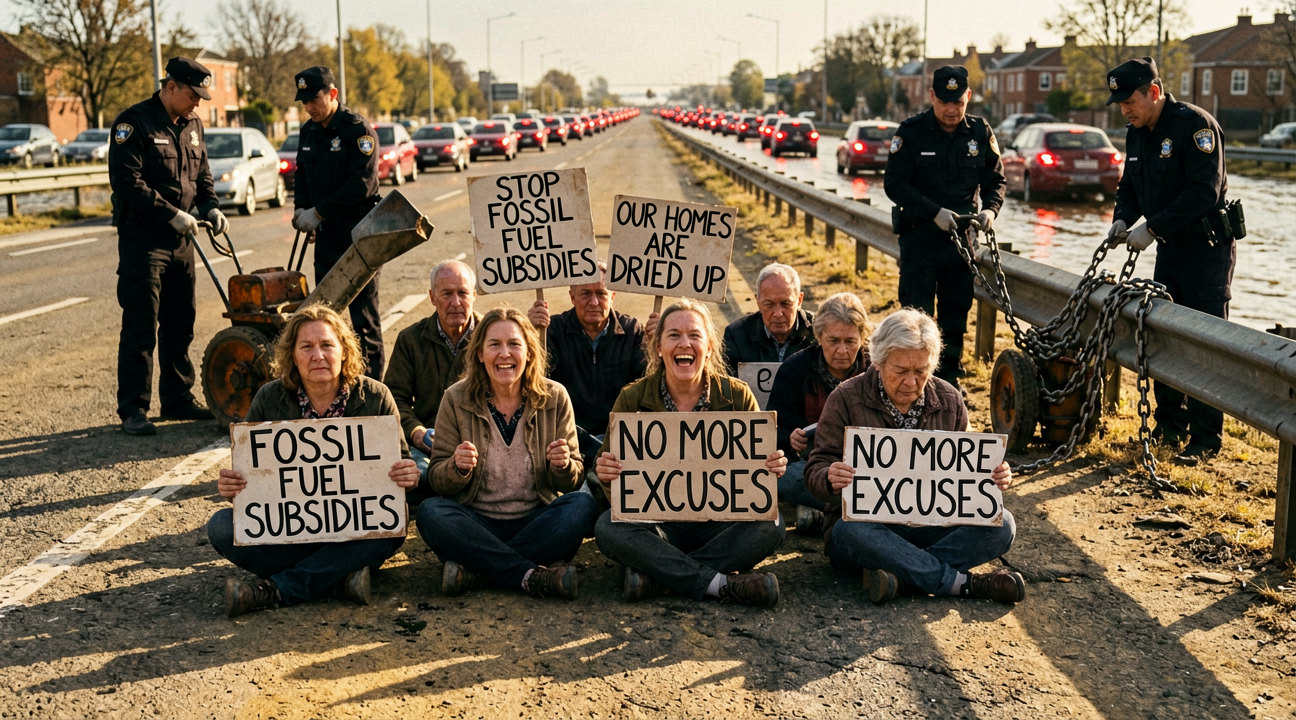
In a bold display of modern civic engagement, hundreds of activists decided that the A12 highway near Utrecht was simply too hot for their liking. Consequently, they sat down on it to prove that fossil fuel subsidies were excessive, while simultaneously ensuring that thousands of commuters spent an extra hour idling in their cars, burning more fuel than they would have if they had just driven past them.
The Blockade
The blockade began with the usual theatrical flair: protesters gathering at the Laagraven roundabout before migrating to the highway itself. The atmosphere was described as “relatively quiet” — a phrase that suggests the participants were well-behaved enough not to throw eggs, but loud enough to sing sea shanties about rising water levels while sitting on dry asphalt.
It is a poetic contradiction: singing of floods in a place where the only thing flooding is the traffic jam behind them.
Police Response
The police response was swift and efficient, involving more than 200 arrests and a significant amount of industrial glue removal. Some activists had fastened themselves to guardrails with chains and pipes, requiring the use of grinders and what can only be described as chemical assistance to free them from their self-imposed confinement. The sight of police dragging protesters onto buses while others walked away independently created a scene that looked less like a political statement and more like a zoo evacuation where the animals had decided to stay in the cage for a few hours longer.
The Minister Weighs In
Minister Vincent Karremans, representing the Infrastructure and Water Management department, offered a precise assessment of the situation:
I have 0.0 understanding for the action.
This level of numerical specificity is rare in politics, where usually one says they have “little” or “some” understanding. To say zero suggests that the Minister calculated the exact amount of patience required to watch a highway fill up with people singing about climate change and found it lacking entirely.
He noted that blocking highways is life-threatening for road users, employees of Rijkswaterstaat, and emergency workers — a statement that was technically true, though one wonders if the activists considered the life-threatening nature of idling diesel engines while they sang their songs.
The Demands
The demands were clear: an immediate end to fossil fuel subsidies, with money redirected toward housing, healthcare, and decolonial recovery. The irony is palpable when one considers that the very people demanding these changes are often the ones who benefit from the infrastructure they disrupt. By stopping traffic on a major artery like the A12, they effectively halted the movement of goods and services, potentially delaying the construction of the very houses they want built.
The Traffic Aftermath
Traffic was diverted via the A4, A9, and A2, creating 7-kilometer jams in both directions from The Hague and Arnhem. Rijkswaterstaat advised road users to avoid the area or take public transport, even though U-OV warned of delays and cancellations.
It is a classic bureaucratic loop: told to take the train because the car is stuck, only to find the train delayed because the people who run it are also stuck in traffic caused by the people who stopped the cars.
By 3:40 p.m., the A12 was free again, and the buses had departed with their cargo of activists. The road was open for business, but the message remained muddied. The Minister’s “0.0 understanding” stood as a testament to the gap between those who sit around tables discussing sustainability and those who drive past them on highways that are now slightly warmer than before.
In conclusion, the evening proved that while the activists may have secured their place in history books, they also secured a spot in the traffic jam for everyone else. It was a historic achievement in civic restraint — or at least it would have been if anyone had actually listened to the instructions.